Eye health guides · Vision & eye conditions
How your vision can change after 40
Why reading up close often gets harder in your 40s, what else can change, and when it's worth having your eyes checked.
- Updated
- 3 min read
The short answer
- Trouble focusing up close in your 40s is called presbyopia, and it happens to nearly everyone.
- It isn't a disease: the lens inside the eye gradually becomes less flexible.
- Reading glasses, progressive lenses and multifocal contact lenses can all help.
- The chance of conditions such as glaucoma rises with age, often without early symptoms, so regular exams matter more.
From your early to mid 40s, the lens inside your eye gradually becomes less flexible, so focusing up close gets harder. It’s called presbyopia, it happens to nearly everyone and it isn’t a disease. Reading glasses, progressive lenses or multifocal contact lenses can help, and regular eye exams matter more from here on.
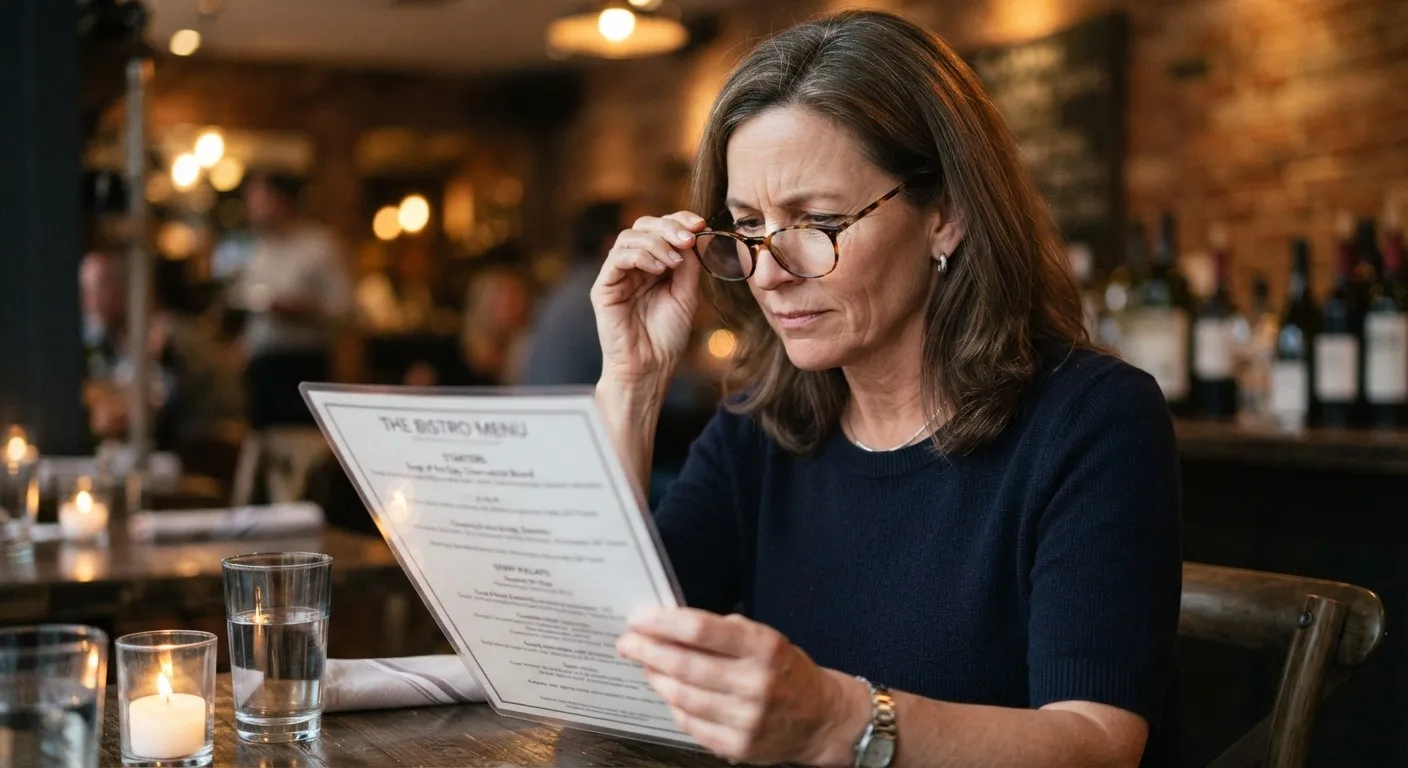
If the print on the menu has been getting smaller and your arms seem a little too short, you’re in good company.
Why does close-up vision change after 40?
Inside your eye is a clear lens that changes shape to focus, a bit like the autofocus on a camera. When you’re young it’s soft and flexible. Over the years it gradually stiffens, and focusing on close things takes more effort.
The name for this is presbyopia. It isn’t a disease, and nothing you did caused it. Most people start to notice it in their early to mid 40s, and it keeps changing slowly into their 60s.
What are the signs of presbyopia?
- Holding your phone or a book farther away to read it
- Needing brighter light for close work
- Tired eyes or headaches after reading
- Blur for a moment when you look up from close work, or back down to it
- Small print that’s harder to read in the evening
What are the options for clear near vision?
- Reading glasses. A simple answer if your distance vision is fine and you only need help up close.
- Progressive lenses. One pair of glasses for distance, the computer and reading, with no visible line across the lens.
- Multifocal contact lenses. Contacts designed to give clear vision at more than one distance. A contact lens exam shows whether they suit your eyes.
Which one suits you depends on your prescription, your work and what you find comfortable.
What else can change?
- Dry eyes. Tear production tends to slow with age. Dry eye is common and can be treated.
- Needing more light, and more trouble with glare. Driving at night can feel harder than it used to.
- Floaters. A few slow-moving specks or threads are common as you get older. A sudden shower of new floaters, or flashes of light, is different and needs to be seen right away.
Which eye conditions become more common with age?
Age is a risk factor for several eye conditions, and some have no symptoms in their early stages:
- Glaucoma, which slowly affects side vision
- Cataracts, a gradual clouding of the lens, usually later in life
- Macular degeneration, which affects the center of your vision
- Diabetic eye disease, if you have diabetes
None of this means something goes wrong at 40. It means a regular look inside the eye becomes more useful.
When should you have your eyes checked?
If close-up vision is getting harder, an exam will show what’s changed and what will help.
Even if you see well, your 40s are a sensible time for a comprehensive eye exam if you haven’t had one recently. It gives your doctor a baseline to compare against in the years ahead.
Sudden changes are different. New flashes of light, a sudden shower of floaters, a shadow or curtain over your vision, sudden blur or eye pain shouldn’t wait for a routine visit.
Sources
- Presbyopia, National Eye Institute
- Adult Vision: 41 to 60 Years of Age, American Optometric Association
- Get an Eye Disease Screening by Age 40, American Academy of Ophthalmology
This guide is general information, not medical advice, and it can't replace an exam. If you're worried about your eyes or your child's, please book a visit or give us a call.